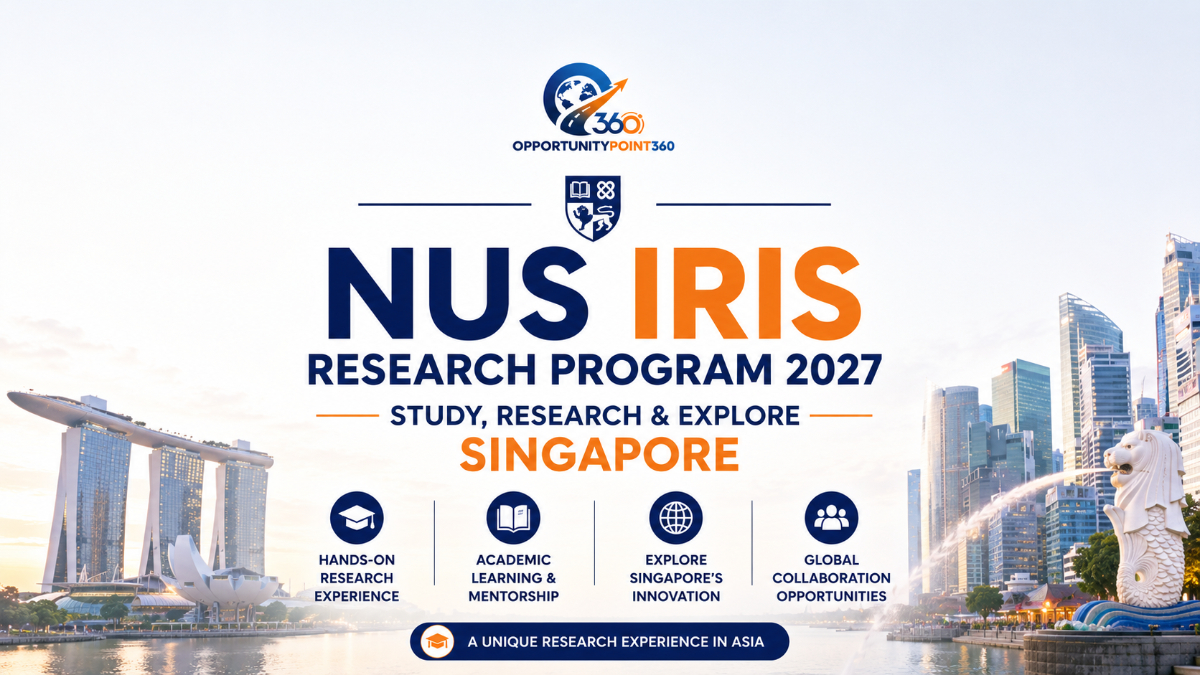
Are you an undergraduate or master’s student looking for an international research opportunity at a world-class university? The Internship and Research Immersion in Singapore (IRIS)@NUS 2027 offers students the chance to spend two or three months conducting research at the National University of Singapore (NUS).
Organized by the NUS Graduate School, the program is open to talented students from different academic backgrounds, including applicants from ASEAN countries and other parts of the world. Participants work under the guidance of NUS faculty members and become part of active research groups.
The program is particularly valuable for students considering a future research career or graduate studies. Participants can gain practical research experience, interact with experienced academics, use advanced facilities, and experience university life in Singapore.
IRIS@NUS 2027 at a Glance
| Feature | Details |
|---|---|
| Program Name | Internship and Research Immersion in Singapore (IRIS)@NUS |
| Host University | National University of Singapore |
| Organizer | NUS Graduate School |
| Location | Singapore |
| Duration | 2 or 3 months |
| Program Period | January–May 2027 |
| Eligible Students | Undergraduate and master’s students |
| Monthly Stipend | SGD 1,200 |
| Travel Support | SGD 600 |
| Accommodation | Complimentary on-campus accommodation |
| Application Fee | None |
| Application Deadline | 28 August 2026, 11:59 PM Singapore Time |
| Expected Results | Week of 2 November 2026 |
What Makes IRIS@NUS Worth Applying For?
IRIS@NUS is more than a conventional internship. Students are placed in research environments where they can contribute to ongoing academic projects and learn how research is conducted at an internationally recognized institution.
Depending on their selected research area and mentor, participants may work with advanced technologies, laboratory facilities, research methodologies, and interdisciplinary teams.
The experience can also help students understand what graduate-level study involves before deciding whether to pursue a master’s, PhD, or research-oriented career.
Key Benefits of the Program
Selected participants can receive several forms of financial and academic support during their stay.
1. Monthly Financial Support
Participants receive a SGD 1,200 monthly stipend, helping them manage everyday expenses during their research placement.
2. Travel Allowance
The program also provides a SGD 600 travel allowance to support eligible travel-related costs.
3. Campus Accommodation
Participants receive complimentary on-campus accommodation, allowing them to live within the NUS environment during their internship.
4. Research Experience
Students become involved with ongoing research projects and gain practical exposure that can strengthen their academic and professional profile.
5. Faculty Mentorship
Participants receive guidance from NUS faculty members and research supervisors throughout their placement.
6. Certificate
Students who successfully complete the program receive a certificate of completion from NUS Graduate School.
7. International Exposure
Living and conducting research in Singapore provides participants with an opportunity to experience a highly international academic environment and interact with researchers from different backgrounds.
Program Duration and Schedule
The IRIS@NUS 2027 intake will take place between January and May 2027.
Students can select a research project lasting either two or three months, depending on the available project and the faculty member’s requirements.
Applicants should carefully check the duration of their chosen project before applying because they are expected to remain available for the complete period selected.
The application deadline is:
28 August 2026 at 11:59 PM Singapore Time (SGT).
Application results are expected to be announced during the week of 2 November 2026.
The organizers have also indicated that selection results are final, meaning appeals will not be considered after decisions are released.
Who Can Apply?
IRIS@NUS is intended for high-performing undergraduate and master’s students who want to develop their research capabilities.
Applicants generally need to meet the following conditions:
- Have a minimum overall or major GPA of 3.5 on a 4.0 scale.
- Be enrolled full-time in an undergraduate or master’s degree at their home institution.
- Maintain active student status throughout the IRIS@NUS placement.
- Undergraduate applicants must have completed at least two years of undergraduate study before the program begins.
- Demonstrate a genuine interest in academic research.
- Current NUS students are not eligible.
Academic performance is important, but applicants should also demonstrate clear motivation for research and explain how the proposed research experience fits into their academic goals.
What Documents Are Required?
Applicants should prepare their application materials carefully because the documents help the selection committee assess academic ability, research potential, and motivation.
Academic Transcript
A current academic transcript is required to demonstrate the applicant’s academic performance.
Curriculum Vitae
Applicants must submit a detailed CV of no more than two A4 pages. The CV should focus on education, research exposure, relevant projects, technical skills, academic achievements, internships, publications, and other experiences related to the selected research area.
Personal Statement
The personal statement should explain the applicant’s academic background, previous experiences, research interests, and reasons for wanting to participate in IRIS@NUS.
Previous research experience is not mandatory, so students who are relatively new to research can still use their statement to demonstrate curiosity, motivation, and a clear interest in developing research skills.
Two Recommendation Letters
Applicants need two letters of recommendation. These should ideally come from professors, faculty members, or supervisors who know the applicant academically and can comment meaningfully on their potential.
The recommendation letters must be received by 6 September 2026.
How Does Mentor Selection Work?
One of the important parts of the IRIS@NUS application is identifying your research interests and preferred mentors.
Students can review the available research projects and identify faculty members whose research aligns with their academic interests.
Applicants can indicate up to three preferred mentors in the application.
However, selecting a particular professor does not guarantee that the student will be assigned to that mentor. Final placement depends on factors such as the applicant’s interests, project suitability, and faculty availability.
To improve the chances of an appropriate placement, applicants should clearly describe:
- Their preferred research field.
- The relevant NUS school or department.
- Their specific research interests.
- Their preferred faculty mentors.
- Why the selected research area fits their academic background.
How to Apply for IRIS@NUS 2027
The application is submitted through the NUS Graduate Admission System (GDA3).
Step 1: Access the Application System
Enter the NUS Graduate Admission System and begin a new application.
Step 2: Select the Correct Program
Then select the option to view programs available for application and choose:
Internship and Research Immersion in Singapore (IRIS)@NUS Program
Step 3: Complete Your Application
Enter the requested personal, academic, and research information accurately.
Step 4: Upload Your Documents
Submit your transcript, CV, personal statement, and other required information through the application system.
Step 5: Arrange Recommendation Letters
Make sure your two referees submit their recommendation letters by 6 September 2026.
Step 6: Review and Submit
Before submitting, carefully check your academic information, research preferences, selected mentors, uploaded documents, and other application sections.
There is no application fee for the program.
How to Strengthen Your IRIS@NUS Application
Because IRIS@NUS is a research-focused opportunity, applicants should avoid treating their application like a general internship application.
Instead, demonstrate a clear connection between your academic background and your proposed research interests.
A strong application could highlight:
- Relevant university coursework.
- Previous laboratory or research exposure.
- Academic projects.
- Research skills and technical abilities.
- Publications or conference participation, if applicable.
- Relevant internships or practical experience.
- A clearly defined research interest.
- Reasons for choosing a particular research area.
- Long-term academic or career goals.
Your personal statement should also explain what you hope to learn from the experience, rather than simply describing why Singapore or NUS is attractive.
Important Dates
Applicants should keep the following dates in mind:
Recommendation letter deadline: 6 September 2026
Application results: Week of 2 November 2026
Program period: January–May 2027
Duration: Two or three months, depending on the selected project
Final Reminder for Applicants
IRIS@NUS 2027 can be an excellent opportunity for students who want to experience research in an international university environment while receiving financial and accommodation support.
Before submitting your application, carefully review the available research projects and choose areas that genuinely match your academic interests. Pay particular attention to project duration and faculty availability, as participants are expected to commit to the full period of their selected placement.
Most importantly, do not wait until the final day to prepare your documents. Your CV, personal statement, academic transcript, and recommendation letters should be organized well before the deadline.
The current application closes on 28 August 2026 at 11:59 PM Singapore Time.
Note
Program details, project availability, eligibility requirements, and application procedures can change. Applicants should always verify the latest information on the official NUS Graduate School IRIS@NUS page before submitting an application.
Next application cycle: Expected at the end of December 2026.