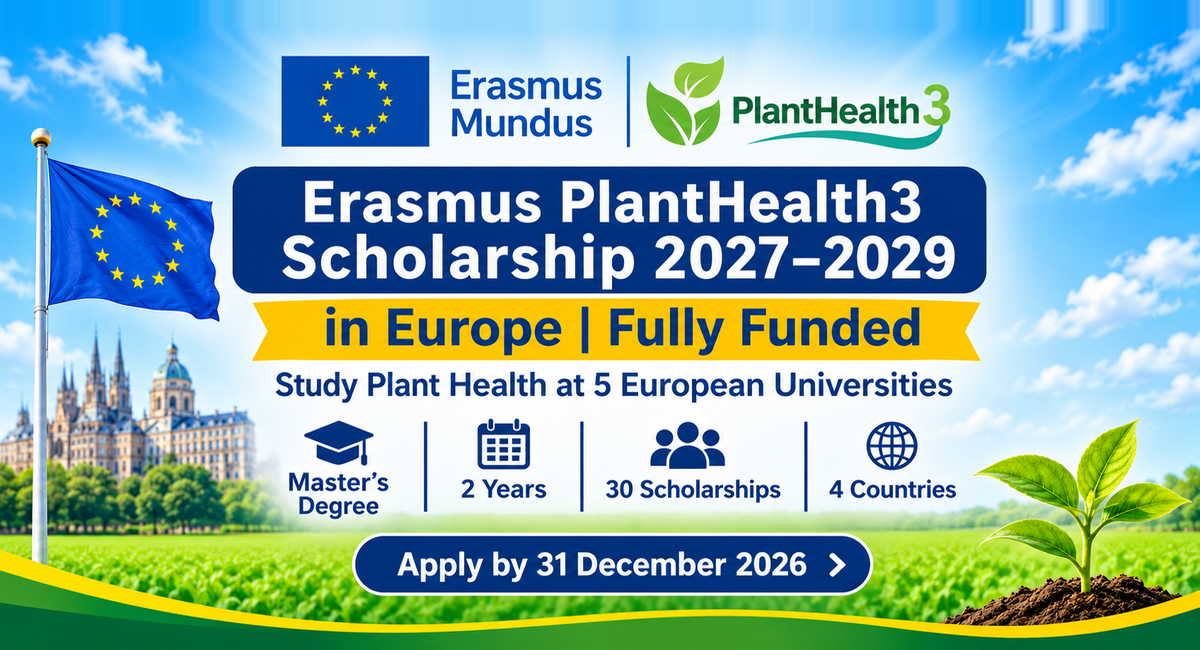
The Erasmus Mundus PlantHealth3 Scholarship 2027–2029 offers international students an opportunity to pursue a fully funded master’s degree in plant health at leading European universities. Supported by the European Union through the Erasmus Mundus programme, this two-year international degree combines advanced academic learning, practical training, and specialised research across four European countries.
The programme brings together five partner universities and welcomes applications from eligible candidates worldwide. Its academic focus includes plant disease management, crop protection, sustainable agriculture, and strategies for maintaining healthy crops. Students can explore the programme’s academic pathways, financial support, admission requirements, and application procedure below.
Erasmus Mundus PlantHealth3 Scholarship 2027–2029: Overview
- Programme Name: Erasmus Mundus Joint Master’s in Plant Health (PlantHealth3)
- Degree Level: Master’s Degree
- Programme Duration: 24 months (two years)
- Study Locations: Partner universities across four European countries
- Funding Organisation: European Union
- Eligible Applicants: International students from eligible countries
- Application Deadline: 31 December 2026
Scholarship Benefits and Financial Support
Selected candidates may receive a comprehensive scholarship package designed to support their studies and living expenses throughout the programme. The advertised benefits include:
- Full tuition coverage: Financial support for the programme’s tuition fees.
- Health and other insurance: Insurance coverage according to the scholarship terms.
- Monthly allowance: €1,400 per month to help cover eligible expenses.
- Living and mobility costs: The monthly funding is intended to contribute towards accommodation, daily living, travel, visa-related expenses, and initial settlement costs, subject to the official scholarship conditions.
Applicants should consult the official programme website to confirm the precise funding arrangements, eligibility conditions, and payment structure for the 2027–2029 intake.
Number of Available Scholarships
The Erasmus Mundus PlantHealth programme aims to recruit up to 30 motivated students from different parts of the world. Competition may be strong, so applicants should prepare a well-organised application that clearly demonstrates their academic background, relevant experience, and interest in plant health.
Participating European Countries
Students undertake their studies within an international academic network spanning these four countries:
- Spain
- Germany
- Italy
- France
This multi-country structure allows students to experience different agricultural systems, research environments, and approaches to crop health and disease management.
Partner Universities
The programme involves the following European institutions:
- Universitat Politècnica de València (UPV), Spain
- L’Institut Agro, France
- AgroParisTech, France
- University of Göttingen, Germany
- University of Padua, Italy
The programme’s official website should be consulted for the confirmed partner institutions, study tracks, and mobility arrangements applicable to the 2027–2029 cohort.
Erasmus PlantHealth3 Programme Structure
The PlantHealth3 master’s degree follows a two-year academic pathway that combines shared foundational training with specialised study and independent research.
First Year (M1): Core Academic Training
During the first year, students build a common academic foundation in plant health and related disciplines. Depending on the assigned pathway, the initial studies take place at one of the following universities:
- Universitat Politècnica de València, Spain
- University of Padua, Italy
This stage establishes the scientific knowledge and technical understanding needed for more focused study during the second year.
Second Year (M2): Specialisation at a Partner University
In the second year, students progress to a partner institution in another country to develop expertise in their selected field. Available study areas described by the programme include:
- Spain: Mediterranean agricultural crops, fruit orchards, and greenhouse production.
- Italy: Temperate fruit crops, ornamental horticulture, and landscape plants.
- Germany: Temperate agricultural crops, arable farming systems, and energy crops.
- France: Tropical horticulture and temperate vegetable production.
These specialisation pathways allow students to explore crop health challenges in different climates and production systems.
Final Semester: Research and Master’s Thesis
The final semester focuses on a research project and the preparation of a master’s thesis. Students investigate a topic related to their chosen specialisation, applying the scientific knowledge and research methods developed throughout the degree.
This research experience can help graduates prepare for further academic study, scientific research, or professional careers in agriculture and plant health.
Eligibility Requirements
Applicants should review the programme’s official admission criteria before beginning their applications. The eligibility conditions outlined in the supplied programme information include:
- Nationality: Applications are open to candidates from countries worldwide, subject to the programme’s rules.
- Academic qualification: Applicants should hold a bachelor’s degree in Agronomy, Agricultural Sciences, or a closely related discipline.
- Final-year students: Students completing their bachelor’s degree may also apply if they meet the programme’s conditions.
- Proof of current studies: Final-year applicants should provide an official university certificate confirming their current enrolment and, where possible, their expected graduation date.
- Recommendation letters: Two reference letters must be included in the application.
- Additional requirements: Applicants should check the official admission guidance and frequently asked questions for any further academic, language, or documentation requirements.
Official programme FAQs: Read the PlantHealth3 Frequently Asked Questions
Degree and Graduation Documents
Successful students may receive the following academic credentials, according to the programme’s degree-awarding arrangements:
- Double master’s degree: Two diplomas awarded by participating universities under the applicable degree structure.
- Joint curriculum document: An official document issued by the programme coordinator describing the PlantHealth master’s curriculum, completed courses, and relevant academic requirements.
These qualifications reflect the programme’s international and multidisciplinary approach to advanced education in plant health.
How to Apply for the Erasmus PlantHealth3 Scholarship 2027–2029
Interested candidates must submit their applications through the programme’s designated online application system. Before applying, applicants should review the admission criteria, prepare their academic records and two reference letters, and check the required supporting documents.
Follow these steps:
- Visit the official PlantHealth3 programme website.
- Review the admission requirements and available specialisation pathways.
- Prepare your academic documents, proof of qualifications or final-year enrolment, and reference letters.
- Complete the online application form and provide the requested information.
- Submit your application before the stated deadline of 31 December 2026, after confirming the deadline and submission requirements on the official website.
Official application and programme information: Apply for the Erasmus Mundus Master’s in Plant Health
Applicants are encouraged to rely on the official programme website for the latest information about scholarships, admission decisions, eligible study pathways, and funding conditions.